 Add to Chrome
 Add to Firefox
 Add to Edge
Multicalibration Boosting: Theory, Convergence, and Transferability
May 23, 2026
Multicalibration extends classical calibration by requiring predictions to be unbiased over a rich collection of functions, encompassing both prediction slices and subpopulations. It has emerged as a powerful framework for fairness, robustness, and reliable prediction, yet the theoretical understanding of multicalibration boosting (MCBoost) remains fragmented and often relies on restrictive assumptions. In this work, we develop a unified and refined perspective on MCBoost that subsumes existing variants, including multiaccuracy, BatchGCP, and BatchMVP. We uncover several phenomena that provide new insights into its practical behavior: even highly accurate and flexible predictors can remain substantially miscalibrated; enforcing multicalibration introduces a calibration-risk trade-off; and early stopping plays a central role in controlling this trade-off. On the theoretical side, we establish a general framework for MCBoost under weaker and more realistic conditions. We show that the boosting iterates converge to a Bregman projection of the population-optimal predictor onto the cumulative span generated by the audit class, thereby explicitly characterizing the function space on which multicalibration is achieved. We further derive convergence rates under different smoothness assumptions, finite-sample guarantees, and principled stopping rules that ensure multicalibration at termination. Finally, we extend the theory of universal adaptability under covariate shift, providing more general transfer guarantees and clarifying when multicalibrated predictors generalize across domains. These results provide a more complete theoretical foundation and practical guidance for multicalibration boosting, positioning it as both a unifying framework and a reliable post-processing approach for modern predictive models.

A Unified Analysis of Multi-task Functional Linear Regression Models with Manifold Constraint and Composite Quadratic Penalty
Nov 09, 2022
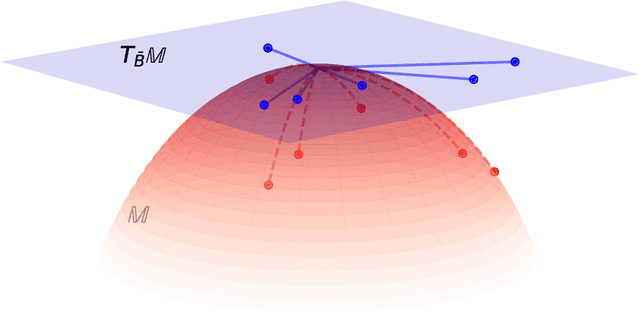
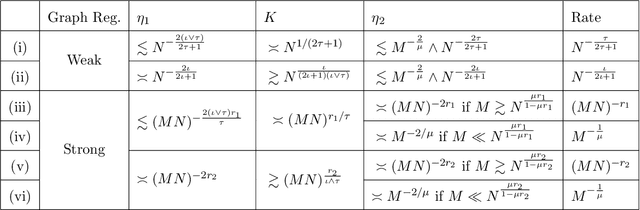
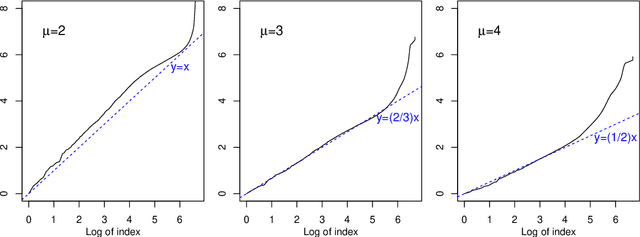
This work studies the multi-task functional linear regression models where both the covariates and the unknown regression coefficients (called slope functions) are curves. For slope function estimation, we employ penalized splines to balance bias, variance, and computational complexity. The power of multi-task learning is brought in by imposing additional structures over the slope functions. We propose a general model with double regularization over the spline coefficient matrix: i) a matrix manifold constraint, and ii) a composite penalty as a summation of quadratic terms. Many multi-task learning approaches can be treated as special cases of this proposed model, such as a reduced-rank model and a graph Laplacian regularized model. We show the composite penalty induces a specific norm, which helps to quantify the manifold curvature and determine the corresponding proper subset in the manifold tangent space. The complexity of tangent space subset is then bridged to the complexity of geodesic neighbor via generic chaining. A unified convergence upper bound is obtained and specifically applied to the reduced-rank model and the graph Laplacian regularized model. The phase transition behaviors for the estimators are examined as we vary the configurations of model parameters.